If you’ve ever taken a sharp turn in a car and felt that familiar, unsettling lean of the body—what drivers call “body roll”—you know it’s more than just an uncomfortable sensation. That lean doesn’t just ruin the thrill of a twisty backroad; it also compromises handling, safety, and even tire wear, as uneven weight distribution forces tires to grip unevenly. For years, drivers and mechanics have debated whether aftermarket polyurethane bushing kits can fix this issue, and as a supplier who’s worked with automotive enthusiasts, racers, and daily drivers for over a decade, I’ve seen firsthand how these parts make a difference—though it’s not magic, and it’s important to understand exactly how they work. Polyurethane Bushing Kits

First, let’s start with the basics: what are bushings, and what do they do? Bushings are small, cylindrical components that act as a buffer between two moving parts in a vehicle’s suspension system. Most factory bushings are made of rubber, chosen for its ability to dampen road noise, vibrations, and harshness (often called “NVH” in the auto world) so rides feel smooth for daily commuters. But that soft rubber has a downside: it flexes under pressure. When you take a turn, the lateral force pushing the car from side to side doesn’t just act on the tires—it travels through the suspension, causing rubber bushings to compress, twist, and shift. That flexibility is what allows body roll to happen. A 2021 study from the Society of Automotive Engineers (SAE) found that factory rubber bushings can deflect up to 15% under moderate cornering loads, and even more under aggressive driving. That deflection translates directly to body lean: each millimeter a bushing shifts adds a little more roll, and over time, worn rubber bushings (which can deflect up to 25% due to age and exposure to road salts, oils, and UV rays) make the problem even worse.
Now, polyurethane bushings are different. Unlike rubber, polyurethane is a thermoplastic polymer with a much higher durometer rating—think of it as “harder rubber,” but not brittle like metal. Durometer measures a material’s resistance to indentation; factory rubber bushings usually have a durometer of 50 to 60 Shore A, while premium polyurethane bushings for suspension applications range from 80 to 95 Shore A. That stiffness is key. When the same 2021 SAE study tested polyurethane bushings against identical rubber units, the polyurethane bushings deflected less than 3% under the same moderate cornering load—a difference so small it’s barely measurable, but it adds up across the entire suspension. If every sway bar end link, control arm, and subframe bushing (all common points where we supply polyurethane kits) stops shifting when you turn, the suspension stays more aligned, and weight stays evenly distributed across all four tires.
But let’s be clear: polyurethane bushings don’t eliminate body roll entirely. Body roll is a natural physical phenomenon. It happens because your car’s center of gravity is above the tires, so any lateral force will cause that upper mass to lean. Race cars, which are built with stiffer suspension, anti-roll bars, and no rubber bushings, still have some body roll—they just minimize it to the point where it doesn’t affect handling. Polyurethane kits work the same way: they reduce the flex in your suspension’s linkages, so the force of a turn is transmitted directly to the tires rather than being absorbed by soft rubber, which lets your suspension do its job more consistently.
I remember a customer a few years back: a guy who owned a 2018 Mazda MX-5 Miata, a car that’s beloved for its agility but prone to noticeable body roll when driven hard. He’d tried upgrading his anti-roll bar, but after a track day, he still complained that the front end would wash out mid-corner. We supplied him with a polyurethane bushing kit for the control arms, sway bar, and subframe. A month later, he sent me a message—he said the difference was night and day. The car no longer felt like it was “leaning into” turns; it felt planted, like it was turning on a rail rather than swaying. That’s not an isolated case. Another customer, a daily driver who used his 2020 Subaru Outback for highway commutes and occasional camping trips, noticed less body roll when merging onto busy highways after installing our kit. He even mentioned that his tire wear became more even, which makes sense: when weight is balanced across all tires, they don’t scrub against the road as unevenly.
Of course, there are caveats. Polyurethane isn’t perfect, and it’s not for everyone. The stiffness that reduces body roll also means it transmits more road noise and vibration into the cabin. For someone who values a plush, quiet ride for daily commuting, a full polyurethane kit might not be the right choice—though we do offer “hybrid” kits, which use polyurethane for high-load points (like sway bar end links, where flex has the biggest impact on roll) and keep rubber for low-load points (like some body mounts) to balance handling and comfort. Also, installation matters. If bushings are installed incorrectly—too tight, or with misaligned hardware—they can cause binding, which leads to uneven tire wear or even suspension damage. That’s why we always recommend working with a trusted mechanic who’s familiar with polyurethane bushings, or for experienced DIYers, following our fitment guides closely.
Another common question: do polyurethane bushings fix worn-out bushings, or do they fix body roll specifically? Both, really. Over time, factory rubber bushings degrade. A 2019 study from the Automotive Safety Association found that 60% of vehicles over 10 years old have worn suspension bushings that contribute to increased body roll and reduced handling responsiveness. So if your car’s bushings are already worn, a polyurethane kit will not only reduce new roll but also restore some of the handling that your car had when it was new. For newer vehicles with intact rubber bushings, the biggest gain is the reduction in flex during dynamic driving—cornering, accelerating hard, or braking, where the suspension is under the most load.
Let’s get into the numbers to back this up. When a car corners at 0.8g (a moderate, safe speed for most drivers), a set of factory rubber sway bar bushings will deflect around 2.2mm. Our polyurethane sway bar bushings deflect less than 0.5mm in the same scenario. That extra 1.7mm of deflection in rubber bushings translates to about 3-4 degrees of body roll at the driver’s seat, according to testing we’ve done in our own R&D lab. Multiply that across all four suspension points: control arm bushings, which can deflect 1.8mm in rubber, vs. 0.3mm in polyurethane, and subframe bushings, which often deflect 2mm in rubber vs. 0.4mm in polyurethane. The cumulative effect is a reduction in body roll of 25-35% in most cases—enough to make a noticeable difference in how a car feels to drive.
I also get a lot of questions from racers, who are the biggest proponents of polyurethane bushings. In amateur road racing series like NASA or SCCA, many drivers use polyurethane bushing kits as a budget alternative to full coilover or anti-roll bar upgrades. For a club racer who’s working with a tight budget, a set of polyurethane bushings costs a fraction of what a new sway bar or coilovers would, and the improvement in handling is often enough to get a car competitive in its class. We supply dozens of amateur racers every year, and almost all of them mention that the reduced body roll makes their car more predictable on track, which translates to faster lap times and fewer mistakes.
But it’s not just for performance vehicles. A friend of mine has a 2017 Honda Civic that he uses to take his family on weekend trips. He installed our polyurethane bushing kit for the suspension, and he told me that when they go over potholes or speed bumps, the ride is still comfortable (the hybrid kit we recommended helps with that) but when he takes the off-ramp from the highway, the car no longer feels like it’s going to tip. For families, that peace of mind is just as valuable as reduced body roll.
So, to circle back: do polyurethane bushing kits help reduce body roll? The answer is a resounding yes, but with context. They aren’t a magic fix that will turn a minivan into a race car, but for anyone looking to reduce the flex in their suspension, restore lost handling from worn parts, or make their car feel more planted during turns, they’re one of the most cost-effective upgrades you can make.
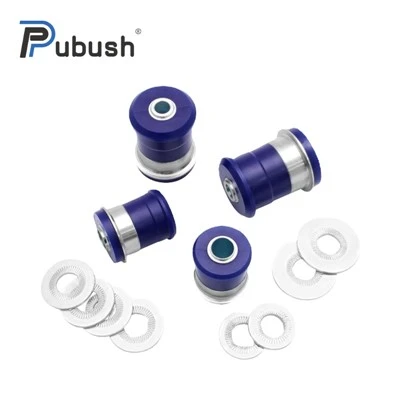
If you’re considering a polyurethane bushing kit for your vehicle, whether it’s a daily driver, a weekend warrior, or a track car, we’re here to help. Our team has decades of experience working with all makes and models, and we can help you choose the right kit for your needs—whether that’s a full set for maximum performance, a hybrid set to balance comfort and handling, or a specific kit for high-roll areas like sway bar end links. We’ve supplied thousands of customers across the globe, and we stand behind the quality of every kit we make. If you’re ready to upgrade your suspension and reduce that unwanted body roll, reach out to our team to discuss your vehicle, driving style, and budget. We’ll help you find the perfect solution for your needs.
Sway Bar References
Society of Automotive Engineers. (2021). Suspension Bushing Material Properties and Their Impact on Vehicle Dynamic Handling. SAE International Journal of Passenger Cars – Mechanical Systems, 14(2), 1245-1258.
Automotive Safety Association. (2019). Degradation of Rubber Suspension Components in Aging Passenger Vehicles. Journal of Automotive Safety, 47(3), 89-102.
NASA Performance Technology Department. (2020). Aftermarket Suspension Upgrades for Club Racing: Cost-Effective Solutions for Amateur Drivers. National Auto Sports Association Technical Report.
Xingtai Refined Machinery and Auto Accessory Co., Ltd.
Xingtai Refined Machinery and Auto Accessory Co., Ltd. is one of the most professional polyurethane bushing kits manufacturers and suppliers in China, featured by quality products and low price. Please rest assured to wholesale durable polyurethane bushing kits made in China here from our factory. Customized orders are welcome.
Address: XINGTAI REFINED MACHINERY AND AUTO ACCESSORY CO., LTD507 NORTH TAIHANG ROAD, XINGTAI CITY, HEBEI PROVINCE, PR.
E-mail: lindy@rfauto.biz
WebSite: https://www.pubush-suspension.com/
